Saturday, February 26, 2011

Tahoe Meadows: fragile in summer, snow-covered in winter


Tahoe Meadows is easily accessible via State Route 431 (Mt. Rose Highway) between Reno and Incline Village in northwest Nevada. In summer, there is a Nature Trail and the trailhead for the Tahoe Rim Trail section to Diamond Peak and the Twin Lakes as well as the Ophir Creek Trail. In Winter, Tahoe Meadows is a snowfield, inviting snowshoers and cross-country skiers or cross-meadows skiers. The meadowlands are a fragile habitat in summer. Visitors are asked to stay on designated trails. But a thick layer of snow is typically covering the meadows during winter and early-spring months. You then define your own trail as you walk or ski across or near lodgepole pines. On a windy day there is a good chance to see rippled clouds and some paraskiers speeding over the wide field.

Sunday, January 23, 2011

Playing tag with the waves at Limantour Beach


Limantour Beach is part of the Point Reyes National Seashore north of San Francisco. In the Tenth Anniversary Issue of Bay Nature, Jon Carroll shares her experiences and romances in snapshots— memories from the last 35 years of joy at this spit of land. Here, young and old like to play tag with the waves or play with kelp turned into jump ropes, while harbor seals are watching and wondering about the activities next to the surf. A wonderful place this is, where fog and wind come and go as certain as their human visitors.

Reference
[1] Jon Carroll: In the Third Kind of Fog. Bay Nature January-March 2011, pp. 16-17 [http://baynature.org/articles/jan-mar-2011/in-the-third-kind-of-fog].

Tuesday, December 21, 2010

On the sculpture trail: frog in the snow


This frog is sitting on a wall next to the entrance of an elementary school complex. The name of the school can be read in the frog's background: Schule am Baumschulenweg, written in colorful letters by school children.

The Schule am Baumschulenweg is a school of the city of Bremen in northern Germany. Brick walls and concrete floors are often the dominating features of German school buildings and adjacent sites. However, times are changing (or have changed already). This school gets kids actively involved in nature project. The concrete yard is turned into a nature playground, in which kids are introduced to environmental topics and to natural science. After all, Baumschule means tree nursery.

Getting there
From the central station, take the light-rail line number 6 going to the University. Exit at the intersection Emmastrasse/H.-H.-Meier-Allee. Walk along the H.-H.-Meier-Allee in northeast direction past the post office. The frog and school entrance is less than 5 minutes away, depending on fresh-snow accumulation.

Monday, December 20, 2010

On the sculpture trail: Heini Holtenbeen in Bremen's medieval Schnoor district


Heini Holtenbeen is walking through the snow looking for a table. This is a bronze sculpture to be found at the corner “Hinter der Holzpforte” in Bremen's Schnoor. The sculptor is Klaus Homfeld (also: Claus Homfeld) [1], who created realistic art work displayed at various locations in northern Germany.

Heini Holtenbeen was a real person. His real name was Jürgen Heinrich Keberle (1835-1909) [2,3]. The story goes that he fell out of a skylight window and, since then, his way of walking was impaired. Hence, his nickname: the Lower German (Plattdeutsch) name Holtenbeen means Holzbein in Standard German (Hochdeutsch)—stiff leg in English. Or does holten relate to halten—to rest or stop? There were other oddities about him strolling through the narrow streets of his Schnoor neighborhood. Around lunch time, he placed himself at the entrance of the cotton exchange building (Baumwollbörse), where he eased the in-going traders from their half-smoked cigarettes. There was no smoking allowed inside the cotton exchange.

An herbal liquer has been named in honor of this original fellow. Good to know that a bitter spirit —and not a brand of cigarettes—is carrying his nickname. Zum Wohl!

References and more to explore
[1] Als K
ünstler immer im Unruhestand. Bildhauer Claus Homfeld.
[2]
Die Geschichte von Heini Holtenbeen und dem Kräuterlikör. www.heiniholtenbeen.de/geschichte_krauterlikoer.php.
[3]
Jürgen Heinrich Keberle (1835-1909). www.bremer-geschichtenhaus.de/de/ausstellung/heini-holtenbeen.html.

Monday, December 13, 2010

Lichen back from space


These lichen samples were shown to the public at the COSPAR 2010 Meeting (www.cospar2010.org) this summer in Bremen, Germany. The lichen has an interesting history of traveling. In June 2005, it was send into space with BIOPAN (‘biological pan’) mounted externally to a Russian re-entry capsule. BIOPAN is a multi-user facility, which can be opened in space by telecommand to expose biological samples to the “local” conditions.

The lichen samples in the picture were exposed to the full spectrum of solar light including UV, cosmic rays, space vacuum, microgravity and extreme temperatures. Their BIOPAN container was closed and hermetically sealed during re-entry and return to Earth.

The lichens survived their exposure to space conditions during a two-week flight and resumed their metabolism on Earth. Although lichens live and thrive in harsh planetary environments such as desert rocks in Nevada, their space survival is a surprise. In the past, some scientist (and science fiction authors) have argued that lichens and other organisms might arrived on Earth via “space flight.” The current findings give more credit to such possibilities. But what natural system achieves the critical protection for organisms to enter the atmosphere from outer space and reach Earth's surface intact?

Thursday, December 9, 2010

A silvery whale in Bremen


At a hasty glance, this shiny building may be mistaken for a giant whale. Actually, the silvery construction is housing the Universum Science Center Bremen. It was designed by architect Thomas Klumpp. The Universum features a permanent exhibition and frequently adds special exhibitions. The concept is hands-on experiencing of nature and technology.

The Universum is located near the University of Bremen. This area has been a wetland, and still is. Various narrow trails can be found between buildings, ponds, canals, and beer gardens. Small nature preserves, study areas and the city forest (Bremer Stadtwald) are nearby. Students as well as Bremer (city residents) and visitors come her for jogging, biking, swimming, surfing, paddling, rowing, horse riding, kite flying and live music events. This former, frequently flooded lowland has turned into a multiverse—for real.

More on locatation, exhibits and events
Address: Universum Bremen, Wiener Str. 1 a, 28359 Bremen.
Getting there: From the airport or the central station, take light rail No. 6, exit at the “Naturwissenschaften 2” stop and walk (less than 5 min.) to the Wiener Str./Unversitätsallee intersection.
About the Universum: http://universum-bremen.de/en/home/about-us.html.

Wednesday, December 8, 2010

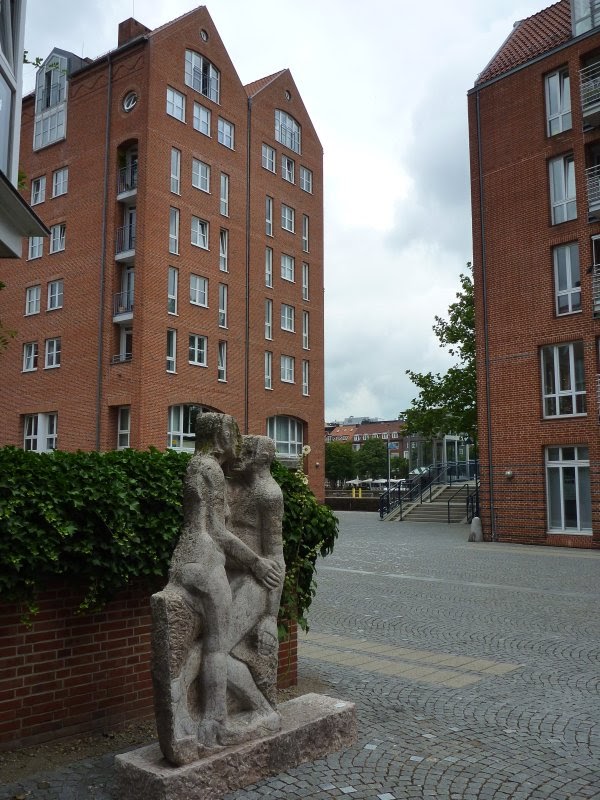
On the sculpture trail: “Pair” by Mareike Seegers in Bremen's Teerhof district


Bremen's Teerhof district is just a few steps away from the Schlachte. A walk over the pedestrian bridge (Teerhofbrücke), crossing the Weser river, gets you to the Teerhof “peninsula.” The sculpture “Paar” (meaning pair in English) by Mareike Seegers is located next to the pedestrian alley along the peninsula axis between the modern red-brickstone buildings.

The compositum Teerhof literally means tar court. In the past, ships were here tarred and equipped with what ever it needed to make them sea-going. The historical district got mostly destroyed during World War II. Today's Teerhof, reconstructed with the historic architecture in mind, combines apartment and office buildings—and art. Teerhof's “Neue Museum Weserburg” (The Museum in the River) is a modern art museum, which opened in the year 1991 and is collecting and presenting international and contemporary art.

More about the artist and her work
[1]
Paar von Mareike Seegers (1998) - auf dem Teerhof: http://fotos-bilder.de/Bremen/neustadt/page-0009.htm.
[2] Künstler - Mareike Seegers-Herenda: http://www.atelier-brandt-credo.de/seegers_herenda.html.